
As a yoga teacher and writer, I, Andrea Cintulova, have witnessed how Dharana—the practice of focused concentration—can transform one’s yoga journey. In the early stages of my practice, my mind often wandered, jumping from one thought to another.
But through Dharana, I learned how to anchor my awareness on a single point, which brought clarity, inner peace, and a deeper connection to meditation.
Over the years, I’ve guided many students through this practice, and I’ve seen the profound impact it has on their mental stability and emotional balance.
This article will provide you with a complete understanding of Dharana, its meaning, practice, benefits, and safe application.
What Does the Dharana Mean?
Dharana is the sixth limb of yoga as outlined in Patanjali’s Yoga Sutras. The Sanskrit word “Dharana” comes from the root “Dhri,” meaning “to hold” or “to concentrate.” It refers to the act of fixing the mind on a single point or object.
In essence, Dharana is the art of one-pointed focus. Unlike meditation (Dhyana), which is a continuous flow of awareness, Dharana is the initial step where the practitioner holds the mind steady, resisting distractions.
It serves as the bridge between Pratyahara (withdrawal of the senses) and Dhyana (meditation).
What is the Anatomy of Dharana?
The anatomy of Dharana lies in the connection between the mind, brain, and energy systems:
- The Brain: Dharana activates the prefrontal cortex, which is responsible for focus, decision-making, and attention control.
- The Nervous System: Concentration calms the nervous system, reducing unnecessary sensory impulses and stress responses.
- The Energetic Body: Dharana directs prana (life force) toward a single channel, strengthening inner awareness.
In yogic terms, Dharana creates a steady state where mental energy no longer leaks into distractions but flows toward one intentional focus.
How to Perform Dharana
Practicing Dharana requires patience and discipline. Here’s a step-by-step guide:
- Prepare the Space: Choose a calm environment where you won’t be disturbed.
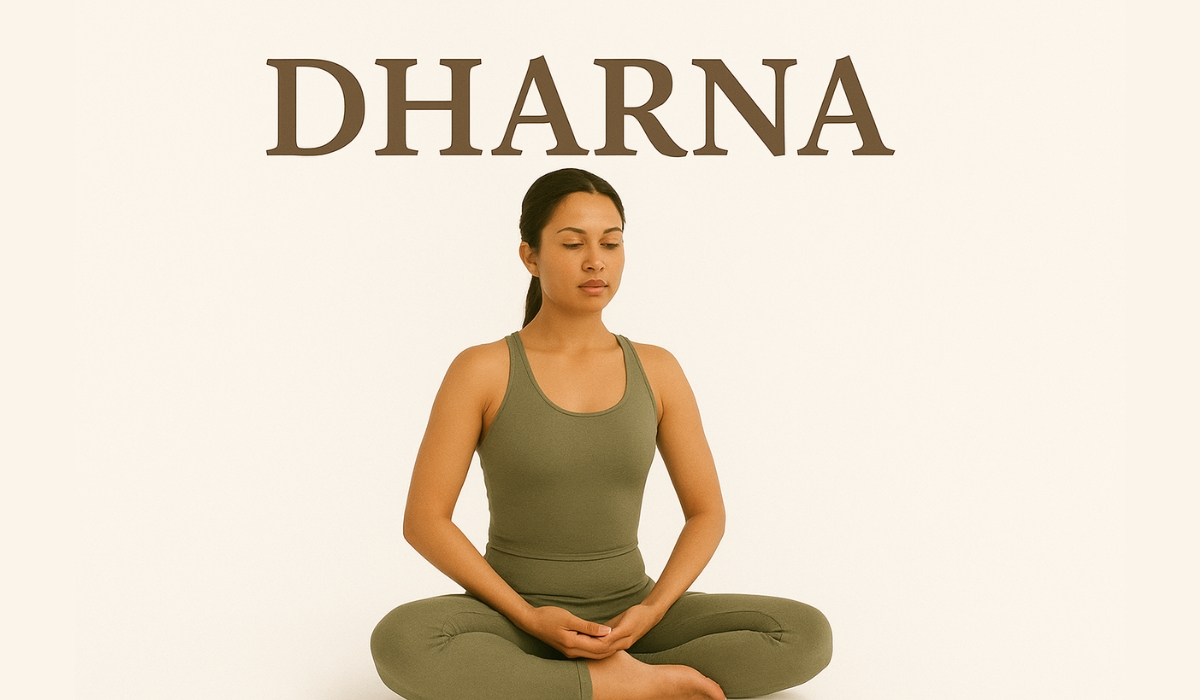
- Sit Comfortably: Use a cross-legged posture on the mat or sit in a chair with your back straight.
- Calm the Breath: Begin with slow, deep breathing to settle the body and mind.
- Choose a Point of Focus: This can be:
- A physical object (like a candle flame or flower).
- A sound (mantra, chanting, or breath).
- An internal visualization (like a chakra or light).
- Fix the Mind: Bring your full awareness to the chosen object. Each time the mind wanders, gently guide it back.
- Practice Regularly: Begin with 5–10 minutes and gradually increase to 20–30 minutes.
Over time, this practice trains the mind to remain steady and prepares it for meditation.
Here’s a video that explains this yoga pose in more detail.
Benefits of Dharana
Dharana strengthens both the body and mind while enhancing spiritual growth. Its benefits can be categorized as follows:
Physical Benefits
- Improves posture by encouraging stillness and awareness.
- Supports better sleep by calming the nervous system.
- Reduces physical fatigue as the body rests in a steady state.
Mental Benefits
- Sharpens concentration and focus in daily tasks.
- Reduces stress and anxiety by training the mind to stay present.
- Enhances creativity and problem-solving skills.
Health Benefits
- Lowers blood pressure through stress reduction.
- Supports brain health by strengthening memory and attention span.
- Boosts immune function by calming the body’s stress responses.
Spiritual Benefits
- Prepares the mind for meditation (Dhyana) and higher states of awareness (Samadhi).
- Encourages inner stillness and detachment from distractions.
- Cultivates self-awareness and spiritual growth.
Variations and Modifications
Dharana can be practiced in many ways, depending on personal preference and comfort:
- Trataka (Candle Gazing): Concentrating on a flame to train focus.
- Mantra Dharana: Repeating a sacred word like Om to anchor the mind.
- Breath Awareness: Observing the flow of breath as the object of concentration.
- Visualization: Focusing on an internal image like a lotus, light, or chakra.
- Object-Based Dharana: Using external objects like flowers, stones, or images.
Beginners may find it easier to start with physical objects before progressing to mental or spiritual anchors.
Expert Insights and Recommendations
From my experience teaching yoga, many students initially feel restless when practicing Dharana. The mind resists stillness because it is used to constant stimulation. The key is gentle persistence. Each time your mind wanders, bring it back with kindness, not frustration.
Experts recommend:
- Start Small – Even 5 minutes daily can build focus.
- Consistency Over Duration – A short, regular practice is more effective than occasional long sessions.
- Combine with Pranayama – Breathing exercises prepare the mind for Dharana.
- Be Patient – Concentration develops gradually; progress often comes in small steps.
Ultimately, Dharana is less about perfection and more about training the mind to return to the present moment.
Safety Precautions
Dharana is generally safe, but a few precautions help ensure a healthy practice:
- Don’t Force Concentration – Forcing the mind may cause frustration or headaches.
- Mental Health Awareness – If you experience trauma, anxiety, or depression, practice under the guidance of a qualified teacher.
- Avoid Overstraining – Begin with shorter sessions to prevent mental fatigue.
- Stay Grounded – Balance Dharana with physical activity and social connection to avoid isolation.
Final Words
Dharana is a powerful practice that teaches us to harness the wandering mind and focus it on a single point. As the sixth limb of yoga, it builds the foundation for meditation and spiritual awakening. With regular practice, Dharana strengthens concentration, improves mental clarity, and nurtures peace within.
As I’ve seen in both my personal journey and my students’ growth, Dharana is not just a yoga practice—it is a life skill. Whether you want to deepen meditation, improve focus at work, or find calm in daily life, Dharana offers a path to mastery of the mind.
FAQs
Q1: How is Dharana different from meditation?
Dharana is focused concentration on one point, while meditation (Dhyana) is the continuous flow of awareness without distraction.
Q2: How long should I practice Dharana daily?
Start with 5–10 minutes, then gradually increase to 20–30 minutes as your focus improves.
Q3: Can beginners practice Dharana?
Yes. Beginners can start with simple techniques like candle gazing or breath awareness.
Q4: Do I need to sit cross-legged to practice Dharana?
No. You can sit on a chair with your back straight as long as you are comfortable and steady.
Q5: What is the ultimate goal of Dharana?
To train the mind in concentration, preparing it for meditation and ultimately leading toward inner peace and spiritual union.
Sources:
Yogapedia. (2023, December 21). Dharana. Yogapedia.
MasterClass. (n.d.). How to Practice Dharana: A Guide to the Sixth Limb of Yoga – 2025 – MasterClass.
Stoenner, C. (2024, January 18). Dharana — concentration of the mind. Bodhi Surf + Yoga.


